


BLAST CHILLERS AND FREEZERS COOK & CHILL
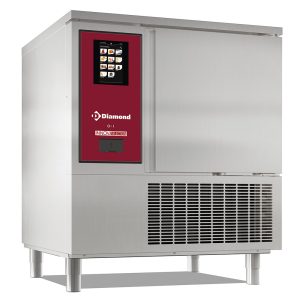
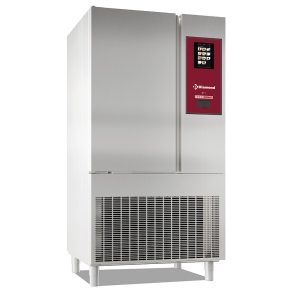
Diamond blast chillers and freezers for Cook & Chill systems rapidly reduce the temperature of freshly prepared food. Models with a capacity of 6 or 10 × GN 1/1 chill 30 to 50 kg of food to +3 °C within 90 minutes or freeze the same quantity to −18 °C within 240 minutes.
Role of blast chilling in Cook & Chill systems
Blast chilling rapidly reduces the temperature of freshly prepared food before storage, transport or later regeneration. Unlike a standard refrigerator, it removes heat from the loaded food through intensive circulation of cold air, significantly reducing the time required to reach the target temperature. In a Cook & Chill system, food is rapidly chilled after cooking in a combi oven, stored at a controlled temperature and regenerated as required before service. This workflow helps preserve the quality, flavour, consistency and appearance of prepared food while simplifying production planning in a commercial kitchen.Capacity of BCC/XT models
- BCC/XT-06-R2 – capacity 6 × GN 1/1. During one cycle, it chills 30 kg of food to +3 °C within 90 minutes or freezes 30 kg to −18 °C within 240 minutes. This model is suitable for restaurants, hotels and operations regularly preparing small to medium-sized batches.
- BCC/XT-10-R2 – capacity 10 × GN 1/1. During one cycle, it chills 50 kg of food to +3 °C within 90 minutes or freezes 50 kg to −18 °C within 240 minutes. Its higher capacity is designed for larger kitchens, catering, banquet production and intensive operations.
Automatic programs and precise cycle control
The full-touch control panel offers automatic programs for different food groups and allows custom programs to be stored for recurring production processes. Chilling and freezing parameters can be monitored in real time. A multi-point core probe measures the temperature inside the food and helps ensure that the selected cycle is completed correctly. Controlled airflow provides consistent cooling throughout the chamber. The adjustable fan speed allows each cycle to be adapted to the type and sensitivity of the prepared food. The units support automatic and manual defrosting, chamber pre-cooling and HACCP data recording.Integration with combi ovens and accessories
BCC/XT models complement Diamond electric and gas combi ovens when organising a Cook & Chill process. Combining these appliances creates an integrated system for cooking, rapid chilling, controlled storage and subsequent food regeneration. Depending on the selected configuration, the process can be supplemented with loading trolleys, banquet racks and insulated covers for safe handling of prepared food.Frequently asked questions
What is the difference between blast chilling and blast freezing?
Blast chilling reduces the temperature of freshly prepared food to approximately +3 °C, allowing it to be stored for a limited period under refrigerated conditions. Blast freezing continues until a temperature of approximately −18 °C is reached and is intended for longer storage. Both processes are considerably faster than cooling or freezing food in a standard refrigerator or freezer.
Why is a standard refrigerator unsuitable for rapid chilling?
A standard refrigerator is primarily designed to maintain food that has already reached the required temperature. When a large quantity of hot food is placed inside, it cannot remove the heat quickly enough and the temperature of other stored products may also increase. A blast chiller uses intensive cold-air circulation and a controlled cycle designed specifically for rapidly reducing food temperature.
Which model should be selected according to production volume?
The BCC/XT-06-R2, with a capacity of 6 × GN 1/1, is suitable for batches of up to 30 kg per cycle. The BCC/XT-10-R2 holds 10 × GN 1/1 and processes up to 50 kg. Selection should be based on the maximum quantity of food prepared in a single production cycle, not only on the operation’s total daily output.