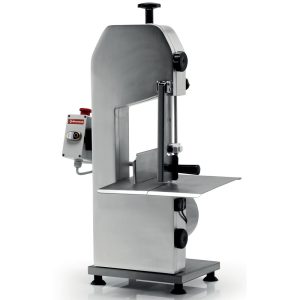
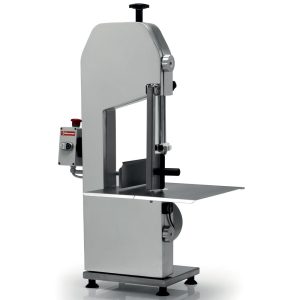
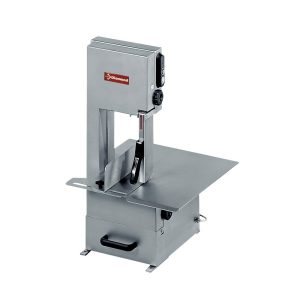
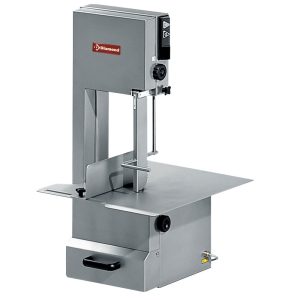
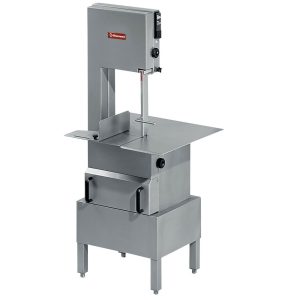
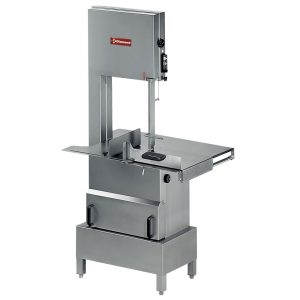
Diamond bone saws are designed for accurate portioning of bones, fresh meat and frozen meat in butcher shops, meat stores, commercial kitchens and food-processing facilities. Available equipment includes tabletop and floor-standing models with blade lengths ranging from 1,550 to 3,100 mm, supplied with anodized aluminum or stainless-steel construction.
When choosing a bone saw, consider the dimensions of products being processed, maximum cutting height, usable cutting width, work surface size, blade length and available power supply. A compact tabletop machine is suitable for smaller cuts, while larger sections require a more spacious work surface and greater cutting capacity.
Tabletop bone saws SA-155/2 and SA-183/2 feature anodized aluminum frames and stainless steel work surfaces. They use blades measuring 1,550 and 1,830 mm, with SA-183/2 providing more space for portioning larger cuts of meat and bones.
Bone saws SAX-165/9 and SAX-202/9 feature full AISI 304 stainless steel construction. Model SAX-202/9 is equipped with a 2,020 mm blade, a 480 × 600 mm work surface and accommodates products up to 290 mm high. Stainless steel construction simplifies thorough cleaning during regular operation.
Floor-standing bone saws SAX-240/7 and SAX-310/7 are intended for larger products and higher processing volumes. SAX-240/7 has a 510 × 710 mm work surface and a maximum cutting height of 350 mm. The largest model, SAX-310/7, combines a 3,100 mm blade with a 795 × 830 mm work surface and a cutting height of up to 420 mm, providing sufficient space for processing large products.
Depending on configuration, equipment may include an adjustable portion guide, stainless steel product pusher, blade scrapers, safety microswitches and a motor brake. Before ordering, it is important to compare cutting capacity, work surface dimensions, power supply and overall machine dimensions with operating requirements. When selecting a replacement blade, remember to verify its length, width and compatibility with the specific bone saw.